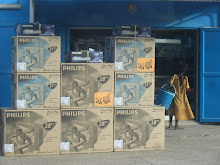
When I walk around downtown Dakar by myself I am usually accosted throughout my entire walk. Someone will come up to me and ask me if I want to buy phone credit, another guy will ask me to buy an ugly t-shirt, a woman will ask me for money, someone else will wave bootleg perfume in my face, etc. It is all done in the most presumptuous manner, since I am white and therefore have money, why wouldn’t I buy a large picture of a marabout or some flip-flops.
Then there are the African fabric guys. These men wait on corners of busy intersections waiting for a toubab to walk by so that he can pounce. The conversation always starts, “What are you looking for?” I always reply in Wolof, “Dara” or nothing. Then they tell you about the wonderful and cheap African fabric they have in their boutique, which is always not far from where you are standing. Don’t want African fabric, well then this guy also sells masks or “beautiful necklaces” which are also not expensive. Sometimes, a “my sistah” gets thrown in to spice up the conversation. After about three of these men with the same schepel, I generally lose my temper and become quite rude.
This weekend I was walking to the bus stop at the bottom of Marche Sandaga, the largest market in Senegal, when after being asked twice if I wanted African fabric, I was met at the top of the market by a man in a red shirt. He did the African fabric schepel and I just kept on walking, which I acknowledge is very rude. Then he called out, “madame, tu es une raciste,” labeling me a racist. Shocked and disgusted, I sharply turned around and spit out a pitiful and sarcastic comeback, “If I am a racist then why do I live in Senegal?” Terrible, I know.
Angrily, I walked down the road racking my brain for a better comeback. It is hurtful to be called something you are not and then defend yourself in a useless way. I decided on a better comeback, “No, sir, I am not a racist; however, I think it is you who has a race problem since out of the people walking by you, I am the only one you spoke to and you call me the racist.” It sounds much better in French. I can admit to be rude and purposefully culturally insensitive. I am incredibly tired of being badgered for money every three seconds while walking alone downtown.
This little anecdote points to a larger issue, once again, of the role foreigners play in Dakar and how Dakaroise treats them. There is a stark difference in how toubabs are treated outside of Dakar and within the confines of the city. That said, in my neighborhood, I am almost always left alone. It is a tiresome and false assumption to battle that all foreign folks have money. However, it falls into a historical and modern context.
Monday, April 27, 2009

Friday, April 24, 2009
Modern-day Fable
A little girl was selling peanuts and papayas for her mother. The sparse goods were arranged in piles on a rickety wooden table in the sun. The girl sat in a plastic chair in the shade facing the table waiting for a customer.
Along came a man dressed in the Senegalese flag. His hair matted, his clothes dirty, and his sandals broken. He hobbled as he walked, with a cane fashioned out of a metal rod. As he approached the table, he spoke to himself in Wolof, gesturing this way and that way. Audaciously he picked up a bag or two of peanuts and hobbled slowly away without paying. A group of boy beggars who had seen the man steal, started chasing the man, beating on their tins calling the man a thief.
The man hobbled past a stranger who had also observed him steal. He looked at her, shook his fist and carried on walking with the chanting boys trailing cautiously but aggressively behind him. The stranger looked at the girl, who looked incredibly sad and cheated watching the man make his way down the road. In her head, the stranger, or toubab as she is called knew that she had enough money in her pocket to reimburse the stolen goods. However, she thought, this is the way that people of this city handle their problems, who am I to interfere. Perhaps it is better to let this be a lesson.
This modern day story is something I recently experienced in my neighborhood. After much thought, I think I made the right decision when I did not run to the rescue and plop down the 50 CFA worth of stolen goods. It was a matter of morals and principles about the relationship between toubabs and the locals and the roles toubabs tend to play.
I say this often but I will write this once again. This time around in Dakar has completely altered the way I think about the world, about Senegal, about Dakar, about rich and poor, about development, about NGOs, and about who should be solving whose problems.
I encourage response, if one feels so inclined.
Along came a man dressed in the Senegalese flag. His hair matted, his clothes dirty, and his sandals broken. He hobbled as he walked, with a cane fashioned out of a metal rod. As he approached the table, he spoke to himself in Wolof, gesturing this way and that way. Audaciously he picked up a bag or two of peanuts and hobbled slowly away without paying. A group of boy beggars who had seen the man steal, started chasing the man, beating on their tins calling the man a thief.
The man hobbled past a stranger who had also observed him steal. He looked at her, shook his fist and carried on walking with the chanting boys trailing cautiously but aggressively behind him. The stranger looked at the girl, who looked incredibly sad and cheated watching the man make his way down the road. In her head, the stranger, or toubab as she is called knew that she had enough money in her pocket to reimburse the stolen goods. However, she thought, this is the way that people of this city handle their problems, who am I to interfere. Perhaps it is better to let this be a lesson.
This modern day story is something I recently experienced in my neighborhood. After much thought, I think I made the right decision when I did not run to the rescue and plop down the 50 CFA worth of stolen goods. It was a matter of morals and principles about the relationship between toubabs and the locals and the roles toubabs tend to play.
I say this often but I will write this once again. This time around in Dakar has completely altered the way I think about the world, about Senegal, about Dakar, about rich and poor, about development, about NGOs, and about who should be solving whose problems.
I encourage response, if one feels so inclined.
Friday, April 10, 2009
The Hamptons of Senegal: Cap Skirring
Last weekend Otman and I took a trip to Cap Skirring in the region of Casamance. The inhabitants of Casamance have staged several separatist movements throughout the past decades; however, now it is calm. Casamance is very different than the Dakar region, it is more green with fruit trees galore. Much to my delight I was able to see a cashew tree, a quest of mine for some time, and learned that cashews grow on the end of a fruit. The fruit, when squeezed, produces a delicious sweet juice. Apparently, if allowed to ferment, the juice can be alcoholic.
Cap Skirring was way too touristy for my liking. There is a direct flight from Paris to the Cap, so many French folks willing to pay very high prices populate the city. Everything was triple the price paid in Dakar. Dakar is expensive as it is, so this was incredible. Also, the quality of service was not great. If Dakar can be equated to New York City, Cap Skirring is like the Hamptons.
The highlights from day one were visiting Dioula (an ethnic group) villages, being told, “it’s sacred” when someone didn’t know the answer to our questions, having a delightful meal and a lively conversation with a radio DJ, and the cashew trees.
Day two, the final day, Otman and I went on a pirogue tour with three French nationals. They asked funny questions and Otman and I laughed privately. I know it is haughty to write that their questions were funny, but it made me realized how adapted I have become to the crazy country. Sample questions were about how to tell if a Senegalese person is rich and whether religious people mix “animism” into their practices. For the latter, our chain-smoking guide declared, “Of course not, for example I am Muslim and I don’t believe in any of that animism stuff. We respect each other’s beliefs completely but I don’t believe in animism.” I asked him if he wears gris-gris for protection and he lifted up his shirt to display several bands of gris-gris wrapped around his stomach. Gris-gris are definitely not “by the book” Islam, but are emblematic of the Islam practiced in Senegal, which is very much a fusion.
Unfortunately, on the trip with the French folks, I got a glimpse at how tourism has affected certain villages on the pirogue tour circuit. There is an utter lack of sustainability. If the separatist movement was to start up and the tourist industry died, I am not sure what would happen. An example of the pervasiveness of tourism is that kids constantly badgered tourists for candy. They attacked in swarms on the unsuspecting tourists, “bon-bon, bon-bon” was chanted until someone relented and purchased some candy. Bad for their teeth and bad for the village.
Since Casamance is a launching point for irregular migration to Spain via pirogues, the Spanish Embassy has invested in public programs to stem the flow. Health centers sponsored by the Spanish Embassy were in most of the villages we visited. Signs stating in French, “I want to go to school and succeed” were sprinkled on the main roads. I am sure a sign with such a proclamation is really helping kids from poor families stay in school.
Some pictures from the trip are below:
 A scared kapok tree in M'Lomp featuring Otman.
 Mangrove on Ile de Karabane
 Walking in the mangroves (the boardwalk)
 Cliche but appropriate village shot of Elinkine
Cap Skirring was way too touristy for my liking. There is a direct flight from Paris to the Cap, so many French folks willing to pay very high prices populate the city. Everything was triple the price paid in Dakar. Dakar is expensive as it is, so this was incredible. Also, the quality of service was not great. If Dakar can be equated to New York City, Cap Skirring is like the Hamptons.
The highlights from day one were visiting Dioula (an ethnic group) villages, being told, “it’s sacred” when someone didn’t know the answer to our questions, having a delightful meal and a lively conversation with a radio DJ, and the cashew trees.
Day two, the final day, Otman and I went on a pirogue tour with three French nationals. They asked funny questions and Otman and I laughed privately. I know it is haughty to write that their questions were funny, but it made me realized how adapted I have become to the crazy country. Sample questions were about how to tell if a Senegalese person is rich and whether religious people mix “animism” into their practices. For the latter, our chain-smoking guide declared, “Of course not, for example I am Muslim and I don’t believe in any of that animism stuff. We respect each other’s beliefs completely but I don’t believe in animism.” I asked him if he wears gris-gris for protection and he lifted up his shirt to display several bands of gris-gris wrapped around his stomach. Gris-gris are definitely not “by the book” Islam, but are emblematic of the Islam practiced in Senegal, which is very much a fusion.
Unfortunately, on the trip with the French folks, I got a glimpse at how tourism has affected certain villages on the pirogue tour circuit. There is an utter lack of sustainability. If the separatist movement was to start up and the tourist industry died, I am not sure what would happen. An example of the pervasiveness of tourism is that kids constantly badgered tourists for candy. They attacked in swarms on the unsuspecting tourists, “bon-bon, bon-bon” was chanted until someone relented and purchased some candy. Bad for their teeth and bad for the village.
Since Casamance is a launching point for irregular migration to Spain via pirogues, the Spanish Embassy has invested in public programs to stem the flow. Health centers sponsored by the Spanish Embassy were in most of the villages we visited. Signs stating in French, “I want to go to school and succeed” were sprinkled on the main roads. I am sure a sign with such a proclamation is really helping kids from poor families stay in school.
Some pictures from the trip are below:
 A scared kapok tree in M'Lomp featuring Otman.
 Mangrove on Ile de Karabane
 Walking in the mangroves (the boardwalk)
 Cliche but appropriate village shot of Elinkine
Thursday, March 26, 2009
My mailman wears five glasses
I finally met my mailman one windy evening around 6:00 pm. I was leaving my house to go to the boutique to buy bread and he was delivering mail. We introduced ourselves his name is Mr. Fall and is very nice. What is remarkable about Mr. Fall was that he had five pairs of glasses on his body. I don’t know why this image has stuck with me for so long but it was so striking that I had to write it down.
Mr. Fall was wearing one pair, a standard large gold-rimmed pair that magnified his eyes. Another pair of sleeker wire rimmed glasses was on top of his head. Another gold pair was prominently clipped to his button-down shirt. And then the jewels peeking out of his jacket pocket, two more pairs, both were tortoise shell and slim. In the middle of our introductions he took a phone call. As Mr. Fall was gabbing away, I took the opportunity to stare at him and recount the glasses on his person. I wonder if they served different purposes or if he changes them depending on his mood. Senegal never ceases to make me wonder about the craziest things.
Mr. Fall was wearing one pair, a standard large gold-rimmed pair that magnified his eyes. Another pair of sleeker wire rimmed glasses was on top of his head. Another gold pair was prominently clipped to his button-down shirt. And then the jewels peeking out of his jacket pocket, two more pairs, both were tortoise shell and slim. In the middle of our introductions he took a phone call. As Mr. Fall was gabbing away, I took the opportunity to stare at him and recount the glasses on his person. I wonder if they served different purposes or if he changes them depending on his mood. Senegal never ceases to make me wonder about the craziest things.
stairs to nowhere
Everyday to get to my office I must climb over a cement barrier in order to cross the Route d'Aeroport highway. These barriers were constructed during the political push to make the (main) roads in Dakar more presentable. The road reconstruction was done for the 2008 Islamic Summit held in Dakar, where various leaders from Islamic nations came to a weeklong conference to talk about the issues plaguing Islam and predominately Islamic countries.
What came out of this conference was a lot of money from the visiting leaders, which has since disappeared into the pockets of various government officials. This is common knowledge, not a conspiracy theory. After the Summit work was stopped on the roads leaving the one in front of my office in limbo. This road, as I mentioned, is a highway with two lanes in each direction, making it a “big road” by Dakar standards.
The barriers that I must climb over everyday were built to prevent cars from making illegal turns, driving on the wrong side of the road, and to give order to the general chaos. It worked and traffic is much more orderly. The current problem is the pedestrians. Pedestrians are not going to walk five minutes out of their way to an intersection sans barrier. No, pedestrians are going to go through an obstacle course to cross the street. Mind you, the majority of the pedestrians are women wearing long skirts with babies on their backs. The barrier reaches my hip so most people have to do a mount-jump move or a swing-the leg-over maneuver. Either way is not easy. I once saw a woman with a baby on her back and butane burner on her head climbing over the cement obstacle. A new Olympic event…
Did I mention that stairs were built to provide a covered passageway over the highway? Yes, stairs were built but not the passageway. Apparently, there won’t be enough money for that construction for another year and a half. Pairs of stairs stick out of the ground like random sculptures dotting the highway landscape.
Street children like to climb and sit on those stairs that lead to nowhere. Sometimes after having climbed over the barrier about ten times in one day, that image becomes exemplary of Senegal’s future if changes aren’t made.
What came out of this conference was a lot of money from the visiting leaders, which has since disappeared into the pockets of various government officials. This is common knowledge, not a conspiracy theory. After the Summit work was stopped on the roads leaving the one in front of my office in limbo. This road, as I mentioned, is a highway with two lanes in each direction, making it a “big road” by Dakar standards.
The barriers that I must climb over everyday were built to prevent cars from making illegal turns, driving on the wrong side of the road, and to give order to the general chaos. It worked and traffic is much more orderly. The current problem is the pedestrians. Pedestrians are not going to walk five minutes out of their way to an intersection sans barrier. No, pedestrians are going to go through an obstacle course to cross the street. Mind you, the majority of the pedestrians are women wearing long skirts with babies on their backs. The barrier reaches my hip so most people have to do a mount-jump move or a swing-the leg-over maneuver. Either way is not easy. I once saw a woman with a baby on her back and butane burner on her head climbing over the cement obstacle. A new Olympic event…
Did I mention that stairs were built to provide a covered passageway over the highway? Yes, stairs were built but not the passageway. Apparently, there won’t be enough money for that construction for another year and a half. Pairs of stairs stick out of the ground like random sculptures dotting the highway landscape.
Street children like to climb and sit on those stairs that lead to nowhere. Sometimes after having climbed over the barrier about ten times in one day, that image becomes exemplary of Senegal’s future if changes aren’t made.
Tuesday, March 10, 2009
Sans-elec Senelec
We call Senelec, the electric company, Sans-elec (without electricity) since the hot season (my terminology, not official) the power goes out on a regular basis for hours at a time. Now that I have my own place, I am faced with the realities of bill paying, especially to the horrible Senelec.
Houses in Dakar do no exactly have addresses. To clarify, street names don’t necessarily exist in all places. My street, for example, has neither a name nor a number. My house has a number and my neighborhood has a name so technically my address is villa number 7622 Mermoz Pyrotechnique Dakar, Senegal. There are streets in Dakar that have names or numbers making mail delivery much easier. My mail (all bills) takes forever to arrive at my doorstep. By the time the mailperson decides to head to my sandy street, I have about 3 days to pay the bills.
I wrote this blog in a notebook while in Senelec waiting to pay my electrical bill. I arrived an hour and 15 minutes ago and took a ticket. The ticket reads 303 and the number being called was 239. I anticipate being here for a long time. My other waiting comrades look at me strangely since I am the only toubab in this office. Most toubabs send their maids to wait it out or drop off a check in a drop box. Since I feel that my maid has better things to do than pay bills and I don have a bank account in Senegal, I am obliged to sit here and reread the newspaper a million times.
What is frustrating about Senelec is that there are about 100 people waiting to pay their bill and there is only one cashier open. It kills me not only because I have to wait here but also because there are so many unemployed people in this city and it would not be too difficult to train them to train them in the ways of Senelec. This problem is omnipresent in institutions like the post office, phone company, and at the banks.
I lost my temper at the phone company a couple of months ago when I waited for a hour and a half to be treated terribly by the woman taking down my information. Not only did she insult me personally but she blamed me for screwing up my address. I went to speak to a supervisor who was surprisingly receptive to my criticisms. Did it change anything? No, but I felt better.
So I am sitting here waiting to pay a bill. The idea of waiting to give a mega company that has a monopoly on the electricity more money disgusts me. Senelec doesn’t care whether they make people wait because in the end people have to pay. If you refuse to pay, they cut off your electricity and you still lose. Thankfully my bill is only about $14 for the month of January. I know people that pay $180 for 2 months.
So it’s been an hour and a half and we are on number 240. A man has started complain loudly and provoke a mutiny. He said something to the effect of, “why are you people not speaking up, you are sitting there like idiots.” He got up and left in a huff. This grain of truth motivated me seek out a supervisor. To get to the supervisor I had to speak to two security guards who thought I was telling them a joke when I said I wanted to complain. After being shown to the supervisor’s office, I waited for 20 minutes to see him and he never emerged I asked for another supervisor and was sent to where the “old people”, over the age of 55 in Senegal, go to pay their bills. Their line was considerably shorter. Nobody in that section of the office understood why I was there so I was obliged to retreat to the young people waiting area.
After 3 hours of waiting and 45 people still ahead of me I decided to leave without paying. They were going to close for lunch and prayer since it was Friday and the lunch/prayer break lasts about 2 hours. Additionally, I did not want to wait any longer without the minor satisfaction of watching the numbers increase.
Update, I returned to Senelec the following day, set on paying my bill and acting in a strategic manner. I took a number and left the office to visit my friend Awa. An hour later I returned and realized that there were still 40 people ahead of me. Since I was better equipped to wait, I whipped out a book and read 200 pages (not joking) and played about 17 games of Tetris on my cell phone. In the end, I waited 4 hours in the young people waiting room, through the lunch break, to pay the bill. The woman at the cashier was not friendly and neither was I. She tried to pretend that she didn’t have the change I needed from my bill. I almost lost my temper and screamed but opted for a snarky comment about how I’ve watched her take people’s money for the past four hours and am convinced she has the 3, 750 CFA that I am owed. After taking my money and leaving I was in a terrible mood but was content that I had paid my bill. Unfortunately, this exercise will be repeated until I leave this country or find an old person to pay my bills.
Houses in Dakar do no exactly have addresses. To clarify, street names don’t necessarily exist in all places. My street, for example, has neither a name nor a number. My house has a number and my neighborhood has a name so technically my address is villa number 7622 Mermoz Pyrotechnique Dakar, Senegal. There are streets in Dakar that have names or numbers making mail delivery much easier. My mail (all bills) takes forever to arrive at my doorstep. By the time the mailperson decides to head to my sandy street, I have about 3 days to pay the bills.
I wrote this blog in a notebook while in Senelec waiting to pay my electrical bill. I arrived an hour and 15 minutes ago and took a ticket. The ticket reads 303 and the number being called was 239. I anticipate being here for a long time. My other waiting comrades look at me strangely since I am the only toubab in this office. Most toubabs send their maids to wait it out or drop off a check in a drop box. Since I feel that my maid has better things to do than pay bills and I don have a bank account in Senegal, I am obliged to sit here and reread the newspaper a million times.
What is frustrating about Senelec is that there are about 100 people waiting to pay their bill and there is only one cashier open. It kills me not only because I have to wait here but also because there are so many unemployed people in this city and it would not be too difficult to train them to train them in the ways of Senelec. This problem is omnipresent in institutions like the post office, phone company, and at the banks.
I lost my temper at the phone company a couple of months ago when I waited for a hour and a half to be treated terribly by the woman taking down my information. Not only did she insult me personally but she blamed me for screwing up my address. I went to speak to a supervisor who was surprisingly receptive to my criticisms. Did it change anything? No, but I felt better.
So I am sitting here waiting to pay a bill. The idea of waiting to give a mega company that has a monopoly on the electricity more money disgusts me. Senelec doesn’t care whether they make people wait because in the end people have to pay. If you refuse to pay, they cut off your electricity and you still lose. Thankfully my bill is only about $14 for the month of January. I know people that pay $180 for 2 months.
So it’s been an hour and a half and we are on number 240. A man has started complain loudly and provoke a mutiny. He said something to the effect of, “why are you people not speaking up, you are sitting there like idiots.” He got up and left in a huff. This grain of truth motivated me seek out a supervisor. To get to the supervisor I had to speak to two security guards who thought I was telling them a joke when I said I wanted to complain. After being shown to the supervisor’s office, I waited for 20 minutes to see him and he never emerged I asked for another supervisor and was sent to where the “old people”, over the age of 55 in Senegal, go to pay their bills. Their line was considerably shorter. Nobody in that section of the office understood why I was there so I was obliged to retreat to the young people waiting area.
After 3 hours of waiting and 45 people still ahead of me I decided to leave without paying. They were going to close for lunch and prayer since it was Friday and the lunch/prayer break lasts about 2 hours. Additionally, I did not want to wait any longer without the minor satisfaction of watching the numbers increase.
Update, I returned to Senelec the following day, set on paying my bill and acting in a strategic manner. I took a number and left the office to visit my friend Awa. An hour later I returned and realized that there were still 40 people ahead of me. Since I was better equipped to wait, I whipped out a book and read 200 pages (not joking) and played about 17 games of Tetris on my cell phone. In the end, I waited 4 hours in the young people waiting room, through the lunch break, to pay the bill. The woman at the cashier was not friendly and neither was I. She tried to pretend that she didn’t have the change I needed from my bill. I almost lost my temper and screamed but opted for a snarky comment about how I’ve watched her take people’s money for the past four hours and am convinced she has the 3, 750 CFA that I am owed. After taking my money and leaving I was in a terrible mood but was content that I had paid my bill. Unfortunately, this exercise will be repeated until I leave this country or find an old person to pay my bills.
Thursday, March 05, 2009
wigs, fakes, and gas
As I have previously mentioned, I encounter what I consider “absurdities” on a regular basis. Recently, meaning within the past two days, I have experienced three gems.
The first was during a serious conversation I had with someone I hired for the opening of the cultural center I now work for. We were sitting in her living room talking when she stood up to get a piece of paper. As she stood, she left the wig that she had been wearing on the chair where her head had been. First, what made the situation awkward was that I wasn’t sure if she knew that she was no longer wearing her wig. I had no idea how to handle the situation and I am not sure Mrs. Manners would know either. I decided, in true Senegalese form, to ignore it and let her realize her lack of hairpiece on her own. Second, what was also astounding was how she looked sans wig. I know this woman very well and realized that I have never seen her real hair. It was shocking.
The second event took place at the only “cinema” in Dakar. I use quotation marks because the cinema is also an overpriced restaurant and they get their films from dubious sources. Otman and I went there for the first time to see “Entre les Murs” or “The Class” as it is called in English. My mom recommended the film and I was happy to see that it was playing in Dakar. However, we never got to see the film because the cinema had downloaded a copy of the film from the internet that repeats a ten-minute segment for about two hours. I spoke to the projectionist who admitted to have downloaded the film (it’s not illegal in Senegal) and to have neglected to check its quality. Although, Otman and I got a free drink out of it, I am disappointed that I have not been able to watch this movie.
The last absurd event happened on route home from the movie when Otman needed to put gas in his scooter. At the gas station, we were alerted to the fact that gas pump for the kind of gas Otman gets, a mix of petrol and oil, had a problem. The clever men at the gas station solved the problem by putting the mix into old one-liter juice containers. Using a crude funnel made of a plastic soda bottle, the man filled the tanks one juice container at a time. The process was messy but effective.
These are some of the reasons why I enjoy living in Dakar. These types of events happen often and keep me on my toes and keep me laughing.
The first was during a serious conversation I had with someone I hired for the opening of the cultural center I now work for. We were sitting in her living room talking when she stood up to get a piece of paper. As she stood, she left the wig that she had been wearing on the chair where her head had been. First, what made the situation awkward was that I wasn’t sure if she knew that she was no longer wearing her wig. I had no idea how to handle the situation and I am not sure Mrs. Manners would know either. I decided, in true Senegalese form, to ignore it and let her realize her lack of hairpiece on her own. Second, what was also astounding was how she looked sans wig. I know this woman very well and realized that I have never seen her real hair. It was shocking.
The second event took place at the only “cinema” in Dakar. I use quotation marks because the cinema is also an overpriced restaurant and they get their films from dubious sources. Otman and I went there for the first time to see “Entre les Murs” or “The Class” as it is called in English. My mom recommended the film and I was happy to see that it was playing in Dakar. However, we never got to see the film because the cinema had downloaded a copy of the film from the internet that repeats a ten-minute segment for about two hours. I spoke to the projectionist who admitted to have downloaded the film (it’s not illegal in Senegal) and to have neglected to check its quality. Although, Otman and I got a free drink out of it, I am disappointed that I have not been able to watch this movie.
The last absurd event happened on route home from the movie when Otman needed to put gas in his scooter. At the gas station, we were alerted to the fact that gas pump for the kind of gas Otman gets, a mix of petrol and oil, had a problem. The clever men at the gas station solved the problem by putting the mix into old one-liter juice containers. Using a crude funnel made of a plastic soda bottle, the man filled the tanks one juice container at a time. The process was messy but effective.
These are some of the reasons why I enjoy living in Dakar. These types of events happen often and keep me on my toes and keep me laughing.
Tuesday, February 17, 2009
boom car boom
I was in the neighborhood Fann this afternoon after a meeting at the West African Research Center. I happened to run into a new colleague and stopped to chat. We were standing outside of the ubiquitous Dakar boutiques next to the morgue. Fann is a bustling neighborhood that houses the public university, Universite Cheikh Anta Diop, a major hospital, and many embassies. We were standing near a large intersection, one that has an Oil Libya gas station (used to be Mobil) and the very popular My Shop. My Shop is the hang out place in Fann because it serves “Western” food and alcohol, although it is a gas station restaurant.
So, I was chatting away with Ahmadou, I think that’s his name, when all of a sudden I heard metal crunching. People who were in the post office on the corner came streaming out onto the street. Beer drinking patrons of My Shop peered over the terrace onto the street trying to figure out what happened. Taxi drivers pulled over and gawked, pedestrians ran toward the accident, beggars hobbled over, and I stood still. Suddenly, the people in the morgue came rushing out. I have never seen people move so quickly in my life. Senegal is a place of “non-time” and slow movement, until, apparently, a car accident presents itself. The cleaning ladies and the doctors came shooting out of that building and I am pretty sure it was not to collect a new customer, but simply to watch.
Finally when Ahmadou and I finished our conversation I walked toward the street where the accident had taken place. I couldn’t see that well because there were about 300 people crowded on the road, blocking traffic and making a commotion. The accident seemed to have taken place right in front of a private hospital on the newly built bridge that connects the VDN to Rue Cheikh Anta Diop. Cars, buses, and car rapides that were behind the accident were reserving on the bridge to be able to get to another road (not safe at all). Cars on the other side of the road were stopping to pay respects to the accident, meaning they would make a full stop, take a look, and continue on their merry way.
What was most impressive was the amount of people that materialized to watch (and obstruct) the accident clean up. Where these came from, other than the morgue and the post office, I have no clue. It’s interesting what motivates people’s curiosity and compels them to investigate. I have never seen people rushing like I did today. It was incredible. I don’t think car accidents in the US draw the same kind of attention. Bystanders wouldn’t stop and stare and then argue about the accident at hand. Yes there is rubbernecking but not in the same way. I heard bystanders blaming this person and speculating left and right about the accident, as if it was their accident. People were praying and shouting. I doubt anyone called the police. Ambulances came simply because of the location. Culture is fascinating.
So, I was chatting away with Ahmadou, I think that’s his name, when all of a sudden I heard metal crunching. People who were in the post office on the corner came streaming out onto the street. Beer drinking patrons of My Shop peered over the terrace onto the street trying to figure out what happened. Taxi drivers pulled over and gawked, pedestrians ran toward the accident, beggars hobbled over, and I stood still. Suddenly, the people in the morgue came rushing out. I have never seen people move so quickly in my life. Senegal is a place of “non-time” and slow movement, until, apparently, a car accident presents itself. The cleaning ladies and the doctors came shooting out of that building and I am pretty sure it was not to collect a new customer, but simply to watch.
Finally when Ahmadou and I finished our conversation I walked toward the street where the accident had taken place. I couldn’t see that well because there were about 300 people crowded on the road, blocking traffic and making a commotion. The accident seemed to have taken place right in front of a private hospital on the newly built bridge that connects the VDN to Rue Cheikh Anta Diop. Cars, buses, and car rapides that were behind the accident were reserving on the bridge to be able to get to another road (not safe at all). Cars on the other side of the road were stopping to pay respects to the accident, meaning they would make a full stop, take a look, and continue on their merry way.
What was most impressive was the amount of people that materialized to watch (and obstruct) the accident clean up. Where these came from, other than the morgue and the post office, I have no clue. It’s interesting what motivates people’s curiosity and compels them to investigate. I have never seen people rushing like I did today. It was incredible. I don’t think car accidents in the US draw the same kind of attention. Bystanders wouldn’t stop and stare and then argue about the accident at hand. Yes there is rubbernecking but not in the same way. I heard bystanders blaming this person and speculating left and right about the accident, as if it was their accident. People were praying and shouting. I doubt anyone called the police. Ambulances came simply because of the location. Culture is fascinating.
Thursday, February 12, 2009
La Magal
For many February 14 is Valentine’s day, a faux holiday of Hallmark cards and love. This year in Senegal for the Mourides (an Muslim brotherhood), February 14 denotes the Magal. The Magal marks the anniversary of Cheikh Amadou Bamba’s exile to Gabon, where he stayed for seven years and purportedly prayed on water. Bamba, or Serigne Touba, as he is commonly known, is the founder of the brotherhood and is worshiped as if he was a prophet. He was a deeply religious man that preached adherence to Islam, hardwork, and living simply. He created a mosque and a huge legacy in the city of Touba. Annually Mourides make a pilgrammage to Touba to pray, chant, and feast.
An aside about the Mourides, they are the second largest brotherhood in Senegal, but are the most visible. Generally, Mourides are merchants and have a large network of followers. These networks extend to the USA and Italy where many Mourides remit their pay to larger Mouride foundations. Mourides have a particular handshake and name their stores “Touba” this or “Cheikh Bamba” that. A branch of the Mouride brotherhood is the Baye Falls. Their leader, Lamp Fall was a disciple of Serigne Touba. It’s a long story but these folks are the “alternative” Mourides. They dress in patchwork clothing, have dred locks, and smoke dope. Those who hustle, hassle anyone they see for money for their marabouts (spiritual leader) in the most aggressive and annoying manner possible.
So the Magal is approaching and everywhere you go there are buses, car rapids, taxies, station wagons, SUVs, and cars packed with people headed for Touba. These vehicles are crammed with amplifiers, cooking utensils, clothing, unidentifiable metal contraptions, and lots of sheep. Yesterday a large van parked outside of my house and unloaded twelve bleating sheep and tied them to each other in the most inhumane fashion. The man who unloaded them was wearing patchwork clothing and an absurd “lost boys” a la Peter Pan hat. In any case, around midnight these sheep were reloaded into a truck along with half the contents of my neighbor’s house destined for Touba.
Apparently there are traffic jams on the main highway for miles and miles because half of Dakar is going to Touba. Police escorts are everywhere, taking small-time marabouts to the ultimate marabout, Serigne Mouhamadou Lamine Bara ibn Mouhamadou Fadilou M'Backé, who is the grandson of Serigne Touba. Do not get me started on these hypocritical charlatan marabouts who have more than four wives, pimp little boys as beggars, and control Dakar.
The actual objective of this post was to mention a hypocritical act of someone going to Touba that emphasizes the general loss of meaning in most celebrations. Today I went to visit my old host mother, a kind, generous, and religious woman whose attitude is always positive and accepting. I could not believe when I saw her this afternoon in a state of inner turmoil. While at the market this morning someone stole her cell phone, wallet, and keys from her shopping bag. When she called her cell phone the thief answered and said that he would return her wallet with her ID card, keys, and SIM card but would keep her money and cell phone. He told her to meet in the Almadies, a posh section of Dakar, about ten miles from where she was. After negotiating with him, he agreed to meet her in front of a supermarket. Much closer to her house. She waited for him for an hour or so and he never showed. Initially, when she called him, he apologized for taking her belongings, saying that he was embarrassed to have stolen from an old lady, but he needed the money for the Magal.
After my host mother told me that some jerk stole from her so he could participate in a religious festival which is insistent upon adhering to the Quran, I went into a fit of rage. I will not express my feelings about organized religion here, but all I can say is that this action enforced my feelings tenfold.
An aside about the Mourides, they are the second largest brotherhood in Senegal, but are the most visible. Generally, Mourides are merchants and have a large network of followers. These networks extend to the USA and Italy where many Mourides remit their pay to larger Mouride foundations. Mourides have a particular handshake and name their stores “Touba” this or “Cheikh Bamba” that. A branch of the Mouride brotherhood is the Baye Falls. Their leader, Lamp Fall was a disciple of Serigne Touba. It’s a long story but these folks are the “alternative” Mourides. They dress in patchwork clothing, have dred locks, and smoke dope. Those who hustle, hassle anyone they see for money for their marabouts (spiritual leader) in the most aggressive and annoying manner possible.
So the Magal is approaching and everywhere you go there are buses, car rapids, taxies, station wagons, SUVs, and cars packed with people headed for Touba. These vehicles are crammed with amplifiers, cooking utensils, clothing, unidentifiable metal contraptions, and lots of sheep. Yesterday a large van parked outside of my house and unloaded twelve bleating sheep and tied them to each other in the most inhumane fashion. The man who unloaded them was wearing patchwork clothing and an absurd “lost boys” a la Peter Pan hat. In any case, around midnight these sheep were reloaded into a truck along with half the contents of my neighbor’s house destined for Touba.
Apparently there are traffic jams on the main highway for miles and miles because half of Dakar is going to Touba. Police escorts are everywhere, taking small-time marabouts to the ultimate marabout, Serigne Mouhamadou Lamine Bara ibn Mouhamadou Fadilou M'Backé, who is the grandson of Serigne Touba. Do not get me started on these hypocritical charlatan marabouts who have more than four wives, pimp little boys as beggars, and control Dakar.
The actual objective of this post was to mention a hypocritical act of someone going to Touba that emphasizes the general loss of meaning in most celebrations. Today I went to visit my old host mother, a kind, generous, and religious woman whose attitude is always positive and accepting. I could not believe when I saw her this afternoon in a state of inner turmoil. While at the market this morning someone stole her cell phone, wallet, and keys from her shopping bag. When she called her cell phone the thief answered and said that he would return her wallet with her ID card, keys, and SIM card but would keep her money and cell phone. He told her to meet in the Almadies, a posh section of Dakar, about ten miles from where she was. After negotiating with him, he agreed to meet her in front of a supermarket. Much closer to her house. She waited for him for an hour or so and he never showed. Initially, when she called him, he apologized for taking her belongings, saying that he was embarrassed to have stolen from an old lady, but he needed the money for the Magal.
After my host mother told me that some jerk stole from her so he could participate in a religious festival which is insistent upon adhering to the Quran, I went into a fit of rage. I will not express my feelings about organized religion here, but all I can say is that this action enforced my feelings tenfold.
Wednesday, February 11, 2009
GENSEN
I have been terrible about updating my blog. I can attribute this to my recent change in jobs. I am currently working for GENSEN, an umbrella organization for a bunch of NGO projects that mainly work within ecovillages in Senegal. An ecovillage is a village that pledged to be sustainable, there are various stipulations that must be adhered to in order to be accredited. The villages use alternative energy, grow their food, etc. GENSEN has established mirco-credit projects and literacy programs in these villages. For more about GENSEN, visit: http://www.gensenegal.org/.
My particular project is the Centre Culturel Vivre et Apprendre. I am working with a team of people to create a cultural center that is focused on Senegalese cultural and fosters exchange between foreigners and Senegalese. We offer dance classes, drum classes, Wolof classes, Senegalese cooking classes (with my old host family, the Sambas), a week-end immersion, as well as English, French, and Spanish classes. I am in charge of event coordinating, such as the grand opening on February 28 and a film series. I also do promotion and general coordinating within the center.
A cool project that is starting with the Cultural Center is an ecotourism project where tourists can visit an ecovillage and actually live and participate in village life. The tourists live in the same kinds of structures as the villages, help out in the gardens, and can even use the solar ovens. One of the main destinations is, Dinde Felou, in the Southeast of Senegal next to a chimpanzee reserve, so tourists can visit the park and learn about the various initiatives in the park.

My particular project is the Centre Culturel Vivre et Apprendre. I am working with a team of people to create a cultural center that is focused on Senegalese cultural and fosters exchange between foreigners and Senegalese. We offer dance classes, drum classes, Wolof classes, Senegalese cooking classes (with my old host family, the Sambas), a week-end immersion, as well as English, French, and Spanish classes. I am in charge of event coordinating, such as the grand opening on February 28 and a film series. I also do promotion and general coordinating within the center.
A cool project that is starting with the Cultural Center is an ecotourism project where tourists can visit an ecovillage and actually live and participate in village life. The tourists live in the same kinds of structures as the villages, help out in the gardens, and can even use the solar ovens. One of the main destinations is, Dinde Felou, in the Southeast of Senegal next to a chimpanzee reserve, so tourists can visit the park and learn about the various initiatives in the park.

Thursday, January 29, 2009
times, they are a-changing
Dakar is changing. I have felt it since I returned from Morocco. There are flashier cars, more toubabs, and a greater disparity between the rich and the poor. However, these are just ideas of what I think is changing. I can't actually nail down what has shifted.
Hotels are being put up on the Corniche but who will they serve? Construction is everywhere. Houses are left empty and half-built. At night if you walk around classier areas, there are actually very few lights on. People aren't home because people don't live there. They live in North America or Europe.
Vendors have made it impossible for buses to pass through Marche Sandaga because they have doubled-up the tables in front of the shanty boutiques. There isn't enough space in teh cramped market for vendors, pedestrians, and buses. I was on a bus yesterday taht went through the market and it tapped two people. How can this be allowed to happen?
I have also been made aware of the increase in thefts in the city. Within the past 3 days, I know three people who had money stolen from them. Two of the people had about $1,000 in the bags that were taken. Is the increase in crime a reaction to wealth disparity? Probably.
I know it's useless to write a post about the subtle changes in a country. While changes may happen slowly over time, I felt that in the ten days that I was away, the country had been altered significantly. Whether it's true or not, is unclear.
Hotels are being put up on the Corniche but who will they serve? Construction is everywhere. Houses are left empty and half-built. At night if you walk around classier areas, there are actually very few lights on. People aren't home because people don't live there. They live in North America or Europe.
Vendors have made it impossible for buses to pass through Marche Sandaga because they have doubled-up the tables in front of the shanty boutiques. There isn't enough space in teh cramped market for vendors, pedestrians, and buses. I was on a bus yesterday taht went through the market and it tapped two people. How can this be allowed to happen?
I have also been made aware of the increase in thefts in the city. Within the past 3 days, I know three people who had money stolen from them. Two of the people had about $1,000 in the bags that were taken. Is the increase in crime a reaction to wealth disparity? Probably.
I know it's useless to write a post about the subtle changes in a country. While changes may happen slowly over time, I felt that in the ten days that I was away, the country had been altered significantly. Whether it's true or not, is unclear.
Saturday, January 10, 2009
embassy juxtapositions
While it was always obvious, the difference between the US embassy and other embassies in Dakar, it was recently made apparent by a trip I made to the Moroccan embassy on Otman’s behalf. Let me give some back-story and explain that I recently visited the US embassy to get a document notarized.
The US Embassy is an imposing structure in the center of Dakar. The streets around the building are blocked off by hand-operated barricades and guarded by several men at all times. The security precautions are not uncommon; in fact they are general procedure. What is comical is that as a pedestrian you can walk as close to the building as you want without being questioned, yet cars are stopped and their occupants grilled.
Approaching the building, the most striking aspect is the long line of non-citizens waiting to be seen by the consulate officials. Sometimes this line can grow as long to wrap around the entire building. Each person waits his or her turn to speak to a person behind a plexi-glass window. They present their documents by sliding them through a slit in the window and then, if all is in order, they are allowed to pass through the doors. Through the doors, they must go through a metal detector, have their belongings subject to search and x-ray, and have any electronic item confiscated and put in a drawer. Once inside and past security, people must take a number and wait for it to be called. This can take several hours. Waiting is done on brightly colored wooden benches that lack cushions or ample legroom.
As an American citizen, I flashed my passport to the person behind the window, regretfully cutting in front of the patiently waiting people, as is procedure and was allowed into the security room. I past through security, had my cell phone and ipod taken and then picked my way through the crowded waiting room for non-citizens to the citizen’s waiting room. What a difference! I found a room with plush chairs, air conditioning, and boring business magazines. I also encountered a racist man who thought he deserved to cut in front of people because he is white. That is a whole other story. Anyway, the notarization process took very little time but forced me to walk from one waiting room to the other, each time squeezing by the bored, tired, and frustrated people waiting to hear about their status. After I paid for the document, I was sent outside to wait to be let inside to recuperate my electronic devices. This was the first time that citizens and non-citizens mingled and waited together. The racist man got angry that it took so long to get his cell phone back, while the Senegalese and women from Cape Verde waited patiently talking about their visa troubles.
The Moroccan embassy was another world. I went there as a favor to Otman to get his birth date corrected on his proof of birth certificate, essentially a birth certificate for those not born in a hospital. He had requested and received one a week before in preparation for our trip to Morocco and his new business ventures. Anticipating questioning, I took his passport and his ID card along with copies of his original proof of birth that was hard to read and blurry.
The Moroccan embassy looks like an expansive Senegalese housing compound. There are no barriers between the public and the embassy except for a gate, which is left open. I spoke to the one guard on duty about whom I needed to see. The secretary of the official I was directed to see, came outside to indicate the proper office I had to visit. She escorted me through the building (nicely decorated with couches, carpets, and pictures of the king) to the head official’s office. He greeted me warmly in Arabic and when I told that I am not Moroccan but American, he was just as friendly. I showed him the copy of Otman’s proof of birth that had the wrong birth date. He asked me for Otman’s correct birthday, looked at the distorted and fuzzy scanned copy of the original, and decided that they had made an error. He asked the secretary to write up a new document and make several copies. This was done in no time and notarized in seconds.
As I was waiting (in a comfortable leather chair) I noticed signs on the wall asking people to shut off their cell phones. Another sign below that one said that business must be handled by the person needing the attention, not on behalf of someone, like what I was doing. While I was waiting, a man came in and asked about divorce procedures in Senegal. Another man, with several student identification cards came in to ask another question. There was no set order or procedure in place. I was able to leave after staying only about 10 minutes in total with a corrected proof of birth. I never showed identification nor did I show Otman’s identification. People were polite, kind, and competent. There was none of the gruff and clinical attitude found at the US embassy.
The embassies represent the juxtapositions commonly found in Dakar. The gap between what is considered “developed” countries and “under-developed” countries are, I find, played out in the bureaucratic arenas, such as security or adherence to regulations. What is acceptable in one place is not in another. Bribing officials is the most illustrative example I can conjure. It would never be acceptable in the US, but in Senegal or Morocco, it is a commonplace everyday affair.
The US Embassy is an imposing structure in the center of Dakar. The streets around the building are blocked off by hand-operated barricades and guarded by several men at all times. The security precautions are not uncommon; in fact they are general procedure. What is comical is that as a pedestrian you can walk as close to the building as you want without being questioned, yet cars are stopped and their occupants grilled.
Approaching the building, the most striking aspect is the long line of non-citizens waiting to be seen by the consulate officials. Sometimes this line can grow as long to wrap around the entire building. Each person waits his or her turn to speak to a person behind a plexi-glass window. They present their documents by sliding them through a slit in the window and then, if all is in order, they are allowed to pass through the doors. Through the doors, they must go through a metal detector, have their belongings subject to search and x-ray, and have any electronic item confiscated and put in a drawer. Once inside and past security, people must take a number and wait for it to be called. This can take several hours. Waiting is done on brightly colored wooden benches that lack cushions or ample legroom.
As an American citizen, I flashed my passport to the person behind the window, regretfully cutting in front of the patiently waiting people, as is procedure and was allowed into the security room. I past through security, had my cell phone and ipod taken and then picked my way through the crowded waiting room for non-citizens to the citizen’s waiting room. What a difference! I found a room with plush chairs, air conditioning, and boring business magazines. I also encountered a racist man who thought he deserved to cut in front of people because he is white. That is a whole other story. Anyway, the notarization process took very little time but forced me to walk from one waiting room to the other, each time squeezing by the bored, tired, and frustrated people waiting to hear about their status. After I paid for the document, I was sent outside to wait to be let inside to recuperate my electronic devices. This was the first time that citizens and non-citizens mingled and waited together. The racist man got angry that it took so long to get his cell phone back, while the Senegalese and women from Cape Verde waited patiently talking about their visa troubles.
The Moroccan embassy was another world. I went there as a favor to Otman to get his birth date corrected on his proof of birth certificate, essentially a birth certificate for those not born in a hospital. He had requested and received one a week before in preparation for our trip to Morocco and his new business ventures. Anticipating questioning, I took his passport and his ID card along with copies of his original proof of birth that was hard to read and blurry.
The Moroccan embassy looks like an expansive Senegalese housing compound. There are no barriers between the public and the embassy except for a gate, which is left open. I spoke to the one guard on duty about whom I needed to see. The secretary of the official I was directed to see, came outside to indicate the proper office I had to visit. She escorted me through the building (nicely decorated with couches, carpets, and pictures of the king) to the head official’s office. He greeted me warmly in Arabic and when I told that I am not Moroccan but American, he was just as friendly. I showed him the copy of Otman’s proof of birth that had the wrong birth date. He asked me for Otman’s correct birthday, looked at the distorted and fuzzy scanned copy of the original, and decided that they had made an error. He asked the secretary to write up a new document and make several copies. This was done in no time and notarized in seconds.
As I was waiting (in a comfortable leather chair) I noticed signs on the wall asking people to shut off their cell phones. Another sign below that one said that business must be handled by the person needing the attention, not on behalf of someone, like what I was doing. While I was waiting, a man came in and asked about divorce procedures in Senegal. Another man, with several student identification cards came in to ask another question. There was no set order or procedure in place. I was able to leave after staying only about 10 minutes in total with a corrected proof of birth. I never showed identification nor did I show Otman’s identification. People were polite, kind, and competent. There was none of the gruff and clinical attitude found at the US embassy.
The embassies represent the juxtapositions commonly found in Dakar. The gap between what is considered “developed” countries and “under-developed” countries are, I find, played out in the bureaucratic arenas, such as security or adherence to regulations. What is acceptable in one place is not in another. Bribing officials is the most illustrative example I can conjure. It would never be acceptable in the US, but in Senegal or Morocco, it is a commonplace everyday affair.
Friday, January 02, 2009
step aerobics
I have decided that it is possible to draw parallels between walking around downtown Dakar and step-aerobics. While walking, one must step up, step down, step to the side, walk against resistance, jump, increase speed, and do upper body pivots. Why all of these things? Let me explain.
Sidewalks, firstly, are poorly maintained and therefore are riddled with divots and cracks. There is no continuity to the material used, sometimes it’s cement, others slippery tile, or stone. On tile, sliding is key. If you lift your foot, it is likely that you will fall. To prevent slippage, I do what I call, “the Senegalese shuffle,” which entails walking without picking up my feet. This maneuver is named after the old men and women shuffling around Dakar in their slippers causing a constant “shh shh” noise.
Another consideration when talking about sidewalks are that they are not just for the pedestrians. Merchants, formal and informal, use the ground as their store or workspace making the sliver of sidewalk available for foot traffic very small. You have to squeeze by rows of people hawking items in your face. Vendors hawk shoes, agendas, decorations, underwear, etc from blankets or palettes, which are plopped down haphazardly. One of my favorite displays are locally made sandals that are hung on strings from the supports of a large parasol umbrella. When it’s windy, they blow around smacking people in the face. People crave out spaces on the sidewalk and return daily to sell their items. Many of these vendors use large wooden tables and cram them on the edge of the sidewalk (or even in the street) where shoes, faux pharmaceuticals, fabric, and fruit are sold. Stores that have four-walls and a roof also spill out onto the sidewalk. Merchants display their goods such as children’s bikes, mattresses, and jewelry outside of their physical store to attract potential buyers. Mechanics also do much of their work on the sidewalk leaving almost no room for pedestrians. Walking through a mechanics area has ripped one of my skirts and stained another.
Back to step aerobics, since some sections of the sidewalk are higher than others, therefore the step up movement is imperative. If you are not paying attention you can easily trip over the raised area. The same goes for stepping down. I cannot begin to count how many times I have been walking along and “boom” the sidewalk has disappeared from beneath my feet. It’s a jarring feeling that makes my teeth smash together. Despite the million or so handicap people living in Dakar, there are no accommodations for wheelchairs or crutches. The sidewalks do not have cutouts for the crosswalk areas, instead one must take a big step down. Most people in wheelchairs use the street instead of the sidewalk.
Being forced off the sidewalk is another reason to do the step down movement. In the crowded streets of Dakar, where people do not make room for others on the sidewalk, this is a crucial maneuver. If you don’t anticipate moving over, you will either slam into the on-coming person or topple over. Recently I was in a foul mood and did not feel like being the one to constantly step into the street when someone was approaching me from the other direction. Instead of stepping into the street or doing an upper body pivot. I continued walking and a man carrying a roll of linoleum crashed into my right arm. I swore that the impact of the linoleum smacking my arm shattered my bones to pieces. Actually, it only left a bruise. My lesson was learned. The problem is that stepping down into the street means that you are no longer contending with people and their goods but cars, buses, car rapides, scooters, bicycles, horse-drawn chariots, and wheelbarrows. Essentially, the road is a messy “anything goes” world.
Walking against resistance takes place when all of a sudden a huge pile of sand appears on the sidewalk. The sand is used in construction sites for making cement. Dakar is a city always under construction therefore these sand piles are everywhere. Walking through deep sand isn’t easy even in sandals. Generally, when met with resistance, I walk like a penguin. Awa has scolded me on several occasions for my inability to walk through sand. She cannot understand why I don’t pick up my feet, instead the tip of my shoes flick sand left and right.
The jumping aspect of walking the streets of Dakar is a bit gross. Jumping usually occurs when mysterious muddy water appears on the sidewalk or in the cross walks. Since it hasn’t rained since October, either an open sewer or an overflowing sewer can explain the water. I like to jump over these nasty smelling puddles to avoid dragging the stench home with me on my shoes and pants.
Lastly, increase speed happens when a man decides the best method of getting my attention is to follow me. I don’t find it assuming so I have perfected a swerving zig-zag pattern when walking. Sometimes, I criss-cross the street and ducking into stores or stalls, which sometimes backfires because I accrue more attention. All this said, walking in Dakar, even f I is just four blocks, feels like walking several miles because of the obstacles and constant workout.
 Sand on the sidewalk in a residential neighborhood.
 Cement on the sidewalk in a residential neighborhood.
 Street scene in Yoff. If you look closely there are cows in the street.
Sidewalks, firstly, are poorly maintained and therefore are riddled with divots and cracks. There is no continuity to the material used, sometimes it’s cement, others slippery tile, or stone. On tile, sliding is key. If you lift your foot, it is likely that you will fall. To prevent slippage, I do what I call, “the Senegalese shuffle,” which entails walking without picking up my feet. This maneuver is named after the old men and women shuffling around Dakar in their slippers causing a constant “shh shh” noise.
Another consideration when talking about sidewalks are that they are not just for the pedestrians. Merchants, formal and informal, use the ground as their store or workspace making the sliver of sidewalk available for foot traffic very small. You have to squeeze by rows of people hawking items in your face. Vendors hawk shoes, agendas, decorations, underwear, etc from blankets or palettes, which are plopped down haphazardly. One of my favorite displays are locally made sandals that are hung on strings from the supports of a large parasol umbrella. When it’s windy, they blow around smacking people in the face. People crave out spaces on the sidewalk and return daily to sell their items. Many of these vendors use large wooden tables and cram them on the edge of the sidewalk (or even in the street) where shoes, faux pharmaceuticals, fabric, and fruit are sold. Stores that have four-walls and a roof also spill out onto the sidewalk. Merchants display their goods such as children’s bikes, mattresses, and jewelry outside of their physical store to attract potential buyers. Mechanics also do much of their work on the sidewalk leaving almost no room for pedestrians. Walking through a mechanics area has ripped one of my skirts and stained another.
Back to step aerobics, since some sections of the sidewalk are higher than others, therefore the step up movement is imperative. If you are not paying attention you can easily trip over the raised area. The same goes for stepping down. I cannot begin to count how many times I have been walking along and “boom” the sidewalk has disappeared from beneath my feet. It’s a jarring feeling that makes my teeth smash together. Despite the million or so handicap people living in Dakar, there are no accommodations for wheelchairs or crutches. The sidewalks do not have cutouts for the crosswalk areas, instead one must take a big step down. Most people in wheelchairs use the street instead of the sidewalk.
Being forced off the sidewalk is another reason to do the step down movement. In the crowded streets of Dakar, where people do not make room for others on the sidewalk, this is a crucial maneuver. If you don’t anticipate moving over, you will either slam into the on-coming person or topple over. Recently I was in a foul mood and did not feel like being the one to constantly step into the street when someone was approaching me from the other direction. Instead of stepping into the street or doing an upper body pivot. I continued walking and a man carrying a roll of linoleum crashed into my right arm. I swore that the impact of the linoleum smacking my arm shattered my bones to pieces. Actually, it only left a bruise. My lesson was learned. The problem is that stepping down into the street means that you are no longer contending with people and their goods but cars, buses, car rapides, scooters, bicycles, horse-drawn chariots, and wheelbarrows. Essentially, the road is a messy “anything goes” world.
Walking against resistance takes place when all of a sudden a huge pile of sand appears on the sidewalk. The sand is used in construction sites for making cement. Dakar is a city always under construction therefore these sand piles are everywhere. Walking through deep sand isn’t easy even in sandals. Generally, when met with resistance, I walk like a penguin. Awa has scolded me on several occasions for my inability to walk through sand. She cannot understand why I don’t pick up my feet, instead the tip of my shoes flick sand left and right.
The jumping aspect of walking the streets of Dakar is a bit gross. Jumping usually occurs when mysterious muddy water appears on the sidewalk or in the cross walks. Since it hasn’t rained since October, either an open sewer or an overflowing sewer can explain the water. I like to jump over these nasty smelling puddles to avoid dragging the stench home with me on my shoes and pants.
Lastly, increase speed happens when a man decides the best method of getting my attention is to follow me. I don’t find it assuming so I have perfected a swerving zig-zag pattern when walking. Sometimes, I criss-cross the street and ducking into stores or stalls, which sometimes backfires because I accrue more attention. All this said, walking in Dakar, even f I is just four blocks, feels like walking several miles because of the obstacles and constant workout.
 Sand on the sidewalk in a residential neighborhood.
 Cement on the sidewalk in a residential neighborhood.
 Street scene in Yoff. If you look closely there are cows in the street.
Friday, December 19, 2008
lady in white on the bus
Today was the first time that something of this nature happened to me in Dakar. As usual, I was riding on a crowded bus, and did not have a seat. The young woman sitting in the two-seater next to me stood up to get off the bus. Before sitting down I checked to see if there were any old women or men who could benefit from the seat. There were not, just strapping young men, telling me to “togg-al,” sit down.
I swung my left leg into the seat and the middle-aged woman sitting next to the window put out her hand to block my leg. I thought that she was worried about protecting and maintaining the shiny white color of her boubou, so I tried to sit down again. This time I moved my leg into the seat only a little bit. She blocked my leg again this time speaking to me, not very loudly or clearly. I couldn’t hear what she was saying. I thought maybe she was saving the seat for someone but nobody approached. I was so confused and shocked I had no idea to do. The young men around me continued to tell me to sit and since I was half-way in the seat and stuck, I did. The woman recoiled from me, sliding closer to the window. She opened the window as if to demonstrate her disgust. She muttered something inaudible and reorganized the packages on her lap.
I tried not to show my disbelief at her behavior, since I have never experienced such an incident in Dakar, but I am sure my face turned red with embarrassment. My mind was racing with ways of handling this situation; do I address it or ignore it? I decided to pull out my newspaper and try to read. This seemed to shock my unfriendly neighbor. She was now in a modified fetal position, wrapped over her parcels, against the window, trying not to touch me. Thankfully, I did not have to stay with her long. My stop approached, so I got up and got off the bus in a daze.
I swung my left leg into the seat and the middle-aged woman sitting next to the window put out her hand to block my leg. I thought that she was worried about protecting and maintaining the shiny white color of her boubou, so I tried to sit down again. This time I moved my leg into the seat only a little bit. She blocked my leg again this time speaking to me, not very loudly or clearly. I couldn’t hear what she was saying. I thought maybe she was saving the seat for someone but nobody approached. I was so confused and shocked I had no idea to do. The young men around me continued to tell me to sit and since I was half-way in the seat and stuck, I did. The woman recoiled from me, sliding closer to the window. She opened the window as if to demonstrate her disgust. She muttered something inaudible and reorganized the packages on her lap.
I tried not to show my disbelief at her behavior, since I have never experienced such an incident in Dakar, but I am sure my face turned red with embarrassment. My mind was racing with ways of handling this situation; do I address it or ignore it? I decided to pull out my newspaper and try to read. This seemed to shock my unfriendly neighbor. She was now in a modified fetal position, wrapped over her parcels, against the window, trying not to touch me. Thankfully, I did not have to stay with her long. My stop approached, so I got up and got off the bus in a daze.
Monday, December 15, 2008
looking for a partner?
I picked up a paper where people advertise the goods that they are selling ranging from their pet bird to their villa. At the back of the paper are personal ads and requests for employment. The personal ads are typically Senegalese. The majority of the posters refer to themselves as young and beautiful. Many people, both male and female, write that they are looking for a rich European partner. A woman, aged 38, referred to herself as a young lady, while men over a certain age use “man.” Most of the women use the words, “someone to talk to” and note that they are looking for a serious relationship or someone to marry. The women’s advertisements are short and boring, “Young lady, beautiful, looking for rich European man between the ages of 20 and 30.” Or, “(name) looking for a serious relationship and someone to talk to.” Snooze.
My favorites included “Fatou Diouf, looking for someone to talk to because I have given up on men. If you can convince me otherwise, call the number below.” An interesting and broad ad was a man looking for a European woman to marry between the ages of 20 and 70. Another man wrote that he is looking for a second wife (co-spouse) who is around 40 years old. A good and specific one is, “Man looking for a very sexy woman, in good shape, tall, and practices martial arts.” Another gem from the men’s section is, “Young man, 30 years old, looking for a rich European woman 50 years or older.” If anyone is interested in any of these people, I can provide their phone numbers…
My favorites included “Fatou Diouf, looking for someone to talk to because I have given up on men. If you can convince me otherwise, call the number below.” An interesting and broad ad was a man looking for a European woman to marry between the ages of 20 and 70. Another man wrote that he is looking for a second wife (co-spouse) who is around 40 years old. A good and specific one is, “Man looking for a very sexy woman, in good shape, tall, and practices martial arts.” Another gem from the men’s section is, “Young man, 30 years old, looking for a rich European woman 50 years or older.” If anyone is interested in any of these people, I can provide their phone numbers…
Saturday, December 13, 2008
Les Journals
I love reading the newspaper, but nothing tops reading the newspaper in Senegal. Generally speaking, Senegalese people are much better informed about world events, international and domestic politics, and geography than Americans. People seek out the news by reading the paper, listening to the radio, and watching copious amounts of television. Senegal has over seven different independent daily newspapers and one newspaper run by the government, Le Soleil.
However, my new favorite local paper, L’Obs, is a mix between trashy gossip and hard politics. The paper includes the important suduko puzzles and raunchy jokes, as well as the business, sports, and political news. Sample stories from this accredited newspaper will be summarized below.
As an aside to assuage fears, Senegal is an extremely safe country; violence is very rare and thus noteworthy. That said one of my favorite stories is when two self- described Senegalese thugs, mimicking American gangsters in music videos, (this was included in the article) demonstrated a little violence by wielding guns (real or fake, it is unclear). These two thugs tried to hold up a jewelry store to make a little cash and get some bling. The men drinking tea in the vicinity, described as “locals” came to the owner’s rescue. These men, found in every inch of Senegal are always drinking tea waiting for some action. They beat the thugs so badly that one was sent to the hospital before rejoining his friend in jail.
Another good one, which was reported yesterday, hails from Italy where many Senegalese immigrants live. According to this article, a Senegalese man impregnated his wife’s sister. After this was confirmed, he fled “into the nature.” His wife was quoted saying that she believes this infidelity is her sister’s fault and therefore does not blame her husband. This woman, despite catching her husband and sister in a “loving embrace” did not believe that he was cheating until her sister was visibly pregnant.
The last interesting article illuminates how Dakaroise treat people with mental instabilities. From observation, not from serious research, I have watched Senegalese people tolerate but not accept the many mentally unstable folks living on the streets of Dakar. They are treated as an embarrassment, a sort of pitiful carnival. As an example, the article was describing recent car accidents in Tambacounda, a city in the Southwest of Senegal, about a 14 plus hour drive from Dakar. Unlike Dakar where car accidents are an everyday affair, they are very rare in Tambacounda, especially those that are fatal. Three car accidents happened in one day, injuring two people and killing one. One of the injured was a chief from a nearby village and the other was a motorcyclist. The woman who was killed was a “folle” or crazy, that word was actually used to describe her. Although the journalist knew her name and place of birth, he only used it once. The rest of the article referred to her as the “mentally ill” person.
Mental illness is even joked about in the paper. Last week an article was printed about how the Wade family (Abdoulaye Wade is the President of Senegal) should stay at home on Tuesdays, since “crazy people” have a habit of accosting the family members on Tuesdays.
However, my new favorite local paper, L’Obs, is a mix between trashy gossip and hard politics. The paper includes the important suduko puzzles and raunchy jokes, as well as the business, sports, and political news. Sample stories from this accredited newspaper will be summarized below.
As an aside to assuage fears, Senegal is an extremely safe country; violence is very rare and thus noteworthy. That said one of my favorite stories is when two self- described Senegalese thugs, mimicking American gangsters in music videos, (this was included in the article) demonstrated a little violence by wielding guns (real or fake, it is unclear). These two thugs tried to hold up a jewelry store to make a little cash and get some bling. The men drinking tea in the vicinity, described as “locals” came to the owner’s rescue. These men, found in every inch of Senegal are always drinking tea waiting for some action. They beat the thugs so badly that one was sent to the hospital before rejoining his friend in jail.
Another good one, which was reported yesterday, hails from Italy where many Senegalese immigrants live. According to this article, a Senegalese man impregnated his wife’s sister. After this was confirmed, he fled “into the nature.” His wife was quoted saying that she believes this infidelity is her sister’s fault and therefore does not blame her husband. This woman, despite catching her husband and sister in a “loving embrace” did not believe that he was cheating until her sister was visibly pregnant.
The last interesting article illuminates how Dakaroise treat people with mental instabilities. From observation, not from serious research, I have watched Senegalese people tolerate but not accept the many mentally unstable folks living on the streets of Dakar. They are treated as an embarrassment, a sort of pitiful carnival. As an example, the article was describing recent car accidents in Tambacounda, a city in the Southwest of Senegal, about a 14 plus hour drive from Dakar. Unlike Dakar where car accidents are an everyday affair, they are very rare in Tambacounda, especially those that are fatal. Three car accidents happened in one day, injuring two people and killing one. One of the injured was a chief from a nearby village and the other was a motorcyclist. The woman who was killed was a “folle” or crazy, that word was actually used to describe her. Although the journalist knew her name and place of birth, he only used it once. The rest of the article referred to her as the “mentally ill” person.
Mental illness is even joked about in the paper. Last week an article was printed about how the Wade family (Abdoulaye Wade is the President of Senegal) should stay at home on Tuesdays, since “crazy people” have a habit of accosting the family members on Tuesdays.
Thursday, December 11, 2008
Reflections on Tabaski
I was able to avoid eating sheep during the Tabaski festivities, despite my visits to people’s houses and celebrations I attended. I even managed to avoid eating Otman’s specialty dish of testicles and kidneys in eggs. The only thing that saved me is my body’s inability to digest eggs…
One aspect of Tabaski that I had completely forgotten how beautiful everyone looks in their boubous. Boubous are floor-length or calf-length dresses that are usually long sleeved and worn with pants for men and skirts for women. They are large, airy, and regal. On the whole, Senegalese people dress much better than Americans. They take care to wear nice clothing and look their best especially when leaving the house. However, holidays are the moment when people wear their nicest clothing and get special boubous made out of the nicest fabric, which is called “bazan.” Bazan is a fabric that shines in the light and is solid bright color. There is a subtle pattern throughout the fabric that is only visible up close. Men and women wear the fabric. Colors are not gender based, men wear purple boubous made out of bazan, as well as blue, brown, green, etc. White is only worn by people who have been to Mecca, it is a status symbol and these folks are treated with reverence.
Right before the morning prayers I went to purchase fruit at a market just outside of the downtown area. Men, older women, and young boys were making their way to the mosque. It was an incredible sight to see everyone wearing boubous, since most people, especially the younger generations, generally wear jeans, tee shirts, and other “western” apparel. The colors were so vivid. It was a sea of bright blues, oranges, greens, purples, grays, browns, and pinks. Fathers’, holding prayer rugs under one arm and their son’s hand in the other, was touching. The sons were usually dresses in the same color boubou, while their father wore another color. Women, past menopause, were also headed to the local mosques. Their enormous boubous flapping as they carefully walked in their heeled pointy-toed mules. Their heads wrapped in fabric matching their boubous. Fewer women than men, they stuck out, providing contrast to the sea of colors.
I watched as people walked leisurely toward the mosque, greeting friends and neighbors, wishing everyone a “bonne fete” and apologizing for any wrong-doing they may have unknowingly done (a typical way to greet people during any Seneaglese holiday).
Below are photos from Tabaski. Unfortunately, I wasn’t able to take pictures of people walking
to the mosque.
Little Morocco


Chez Awa


One aspect of Tabaski that I had completely forgotten how beautiful everyone looks in their boubous. Boubous are floor-length or calf-length dresses that are usually long sleeved and worn with pants for men and skirts for women. They are large, airy, and regal. On the whole, Senegalese people dress much better than Americans. They take care to wear nice clothing and look their best especially when leaving the house. However, holidays are the moment when people wear their nicest clothing and get special boubous made out of the nicest fabric, which is called “bazan.” Bazan is a fabric that shines in the light and is solid bright color. There is a subtle pattern throughout the fabric that is only visible up close. Men and women wear the fabric. Colors are not gender based, men wear purple boubous made out of bazan, as well as blue, brown, green, etc. White is only worn by people who have been to Mecca, it is a status symbol and these folks are treated with reverence.
Right before the morning prayers I went to purchase fruit at a market just outside of the downtown area. Men, older women, and young boys were making their way to the mosque. It was an incredible sight to see everyone wearing boubous, since most people, especially the younger generations, generally wear jeans, tee shirts, and other “western” apparel. The colors were so vivid. It was a sea of bright blues, oranges, greens, purples, grays, browns, and pinks. Fathers’, holding prayer rugs under one arm and their son’s hand in the other, was touching. The sons were usually dresses in the same color boubou, while their father wore another color. Women, past menopause, were also headed to the local mosques. Their enormous boubous flapping as they carefully walked in their heeled pointy-toed mules. Their heads wrapped in fabric matching their boubous. Fewer women than men, they stuck out, providing contrast to the sea of colors.
I watched as people walked leisurely toward the mosque, greeting friends and neighbors, wishing everyone a “bonne fete” and apologizing for any wrong-doing they may have unknowingly done (a typical way to greet people during any Seneaglese holiday).
Below are photos from Tabaski. Unfortunately, I wasn’t able to take pictures of people walking
to the mosque.
Little Morocco


Chez Awa


Saturday, December 06, 2008
Sheep on the Brain
I think all of the "mutons" are getting to my head. Tabaski, the celebration in which Muslims sacrifice a sheep, is rapidly approaching. Dakar has become inundated with sheep. On every stretch of once-empty land is now inhabited by "mutons". These "mutons" bleat, excrete, and eat all day long. Despite their frequent washings, they smell terrible. I have often complained about the sheep, but this time their presence is harder than before.
Here is one example, last night I was peacefully sleeping and having a dream about my brother, Douglas in our childhood home. I heard him calling my name, “Steph, Steph.” Abruptly, I woke up to discover that it was not Douglas calling to me but a mutton bleating. I was very unsettled and could not fall back asleep for half and hour after I mistook a sheep’s stupid bleats for my brother’s voice.
Traffic and the markets have also been difficult. Many people have remarked that it is worse (more crowded, more tense) in Dakar than in years past. People push and shove their way through the markets to find their flashy gaudy jewelry, shinny shoes, and sparkling fabric, as well as extra kitchenware. Recently on a packed bus out of the city, the bus was so filled with people’s junk (silver bowls, fruit, buckets, knives, cups, fabric, fish) all wrapped in used rice bags, that very few people could get on the bus without tripping over the packages. I had the pleasure of having on of the packages leak on my foot. The markets, especially the big one downtown, Marche Sandaga, are staying open later than usual, increasing the traffic and general anarchy around the city. These stores blare music and prayers, enticing people (not me) to come and buy.
Awa, Rijak, and I tried to go to the fabric market, Marche HLM, because we head that there was beautiful gold jewelry for sale. We could only handle about five minutes of the pushing shoving, catcalls, and being stepped on. There were so many people it was insane. I cannot describe what it feels like to be in a loud, pulsing, thronging place packed with people who are unbelievably aggressive and not very courteous. We did stop long enough for me to try on some heinously ugly wigs. Rijak took pictures, which I will have to post.
This chaos is thankfully particular to holiday time when people need to demonstrate their wealth (even if they are broke) by getting new clothing made, buying several "mutons" per family, and redecorating their houses. Still, what drives me crazy are the "mutons" and their plentiful excretions.
* "Muton" is the French word for sheep. It is not to be confounded with the English word for sheep's meat mutton. When I think about sheep in Senegal, I think "muton" not sheep, which is why I used the word.
Here is one example, last night I was peacefully sleeping and having a dream about my brother, Douglas in our childhood home. I heard him calling my name, “Steph, Steph.” Abruptly, I woke up to discover that it was not Douglas calling to me but a mutton bleating. I was very unsettled and could not fall back asleep for half and hour after I mistook a sheep’s stupid bleats for my brother’s voice.
Traffic and the markets have also been difficult. Many people have remarked that it is worse (more crowded, more tense) in Dakar than in years past. People push and shove their way through the markets to find their flashy gaudy jewelry, shinny shoes, and sparkling fabric, as well as extra kitchenware. Recently on a packed bus out of the city, the bus was so filled with people’s junk (silver bowls, fruit, buckets, knives, cups, fabric, fish) all wrapped in used rice bags, that very few people could get on the bus without tripping over the packages. I had the pleasure of having on of the packages leak on my foot. The markets, especially the big one downtown, Marche Sandaga, are staying open later than usual, increasing the traffic and general anarchy around the city. These stores blare music and prayers, enticing people (not me) to come and buy.
Awa, Rijak, and I tried to go to the fabric market, Marche HLM, because we head that there was beautiful gold jewelry for sale. We could only handle about five minutes of the pushing shoving, catcalls, and being stepped on. There were so many people it was insane. I cannot describe what it feels like to be in a loud, pulsing, thronging place packed with people who are unbelievably aggressive and not very courteous. We did stop long enough for me to try on some heinously ugly wigs. Rijak took pictures, which I will have to post.
This chaos is thankfully particular to holiday time when people need to demonstrate their wealth (even if they are broke) by getting new clothing made, buying several "mutons" per family, and redecorating their houses. Still, what drives me crazy are the "mutons" and their plentiful excretions.
* "Muton" is the French word for sheep. It is not to be confounded with the English word for sheep's meat mutton. When I think about sheep in Senegal, I think "muton" not sheep, which is why I used the word.
Friday, November 28, 2008
Always Absurd
Below are some aspects of life in Dakar that I find absurd despite my familiarity with the city. As someone who loves all things absurd, this list was carefully constructed and may be added to in the future.
• Men’s pinstripe suits with short sleeve jackets.
• Women’s drawn-on purple eyebrows.
• Obvious and hideous wigs.
• Beggars, generally old men dressed in kaftans, screaming Quranic surahs into megaphones.
• The phasing out of the use of traffic lights. Evidently traffic cops are more efficient.
• Open sewers that meander into the ocean. Also, the ocean being used as a garbage dumping ground.
• Vendors selling the exact same item standing next to each other. The same goes for store selling similar wares like kitchen goods, plastic mats, thread, or gaudy household items. My particular favorite are the phone credit sellers who sell the same phone cards for the same price (they can’t change the price) and stand in clusters trying to hawk their goods.
• Food prices comparable to LA when the average person makes around $5 a day.
• The 50 or so HIV/AIDS non-governmental organizations based in Dakar, while the HIV/AIDS rates are relatively low; while, rates of malnutrition, malaria, unemployment, illiteracy, and general misery are higher than ever.
• Men’s pinstripe suits with short sleeve jackets.
• Women’s drawn-on purple eyebrows.
• Obvious and hideous wigs.
• Beggars, generally old men dressed in kaftans, screaming Quranic surahs into megaphones.
• The phasing out of the use of traffic lights. Evidently traffic cops are more efficient.
• Open sewers that meander into the ocean. Also, the ocean being used as a garbage dumping ground.
• Vendors selling the exact same item standing next to each other. The same goes for store selling similar wares like kitchen goods, plastic mats, thread, or gaudy household items. My particular favorite are the phone credit sellers who sell the same phone cards for the same price (they can’t change the price) and stand in clusters trying to hawk their goods.
• Food prices comparable to LA when the average person makes around $5 a day.
• The 50 or so HIV/AIDS non-governmental organizations based in Dakar, while the HIV/AIDS rates are relatively low; while, rates of malnutrition, malaria, unemployment, illiteracy, and general misery are higher than ever.
Saturday, November 22, 2008
hit and run
Last night I was sitting at outdoor café people watching. This café is unfortunately located next to a canal where sewage travels until dumped into the ocean (nasty, nasty). It does not have the most appetizing smell. Anyway, I was watching two women wearing clothing in the Mauritanian style, which involves draping and tucking until the person is fully covered from head to toe, cross the street. A taxi that was stopped in the middle of the road (for no good reason) began to roll backwards. The taxi hit one of the women who fell onto the road.
I jumped up and ran like a deranged person toward the woman. She was able to stand and did not seem to be hurt. She appreciated my concern since I was the only person of the dozen or so people in the area who came to see if she was ok. I began to yell at the taxi driver for being careless. Another man crossed the street to tell me that it was not this taxi driver’s fault. Instead he laid the blame at another taximan (what taxi driver’s are called) who apparently snatched up the perpetrator’s client. What this had to do with the incident was unclear. After a few seconds of shouting, the taximan pulled away and the two women wrapped in Mauritania cloth walked away.
As an American spectator I was shocked. Although this is not my first run-in with hit and runs, it still amazes me that no numbers were exchanged, calls to the police made, or anything of a formal nature. People shout, blame, and then leave. If that incident happened in New Jersey, the woman would have been able to sue the taximan and get a pretty penny. Instead, she was embarrassed and shuffled home.
I jumped up and ran like a deranged person toward the woman. She was able to stand and did not seem to be hurt. She appreciated my concern since I was the only person of the dozen or so people in the area who came to see if she was ok. I began to yell at the taxi driver for being careless. Another man crossed the street to tell me that it was not this taxi driver’s fault. Instead he laid the blame at another taximan (what taxi driver’s are called) who apparently snatched up the perpetrator’s client. What this had to do with the incident was unclear. After a few seconds of shouting, the taximan pulled away and the two women wrapped in Mauritania cloth walked away.
As an American spectator I was shocked. Although this is not my first run-in with hit and runs, it still amazes me that no numbers were exchanged, calls to the police made, or anything of a formal nature. People shout, blame, and then leave. If that incident happened in New Jersey, the woman would have been able to sue the taximan and get a pretty penny. Instead, she was embarrassed and shuffled home.
Subscribe to:
Posts (Atom)